Recipient visibility
- Central account
- Authorised central groups and sending records can be selected.
- Reseller and sub-account
- Resellers can be limited to records belonging to their own accounts.
Development on request
Messaging & NotificationsReview sending preparation alongside recipient records, reseller balances and provider status reports. We will scope the SMS and reseller management panel we will build around your chosen authorised provider's technical conditions and your business's account structure.
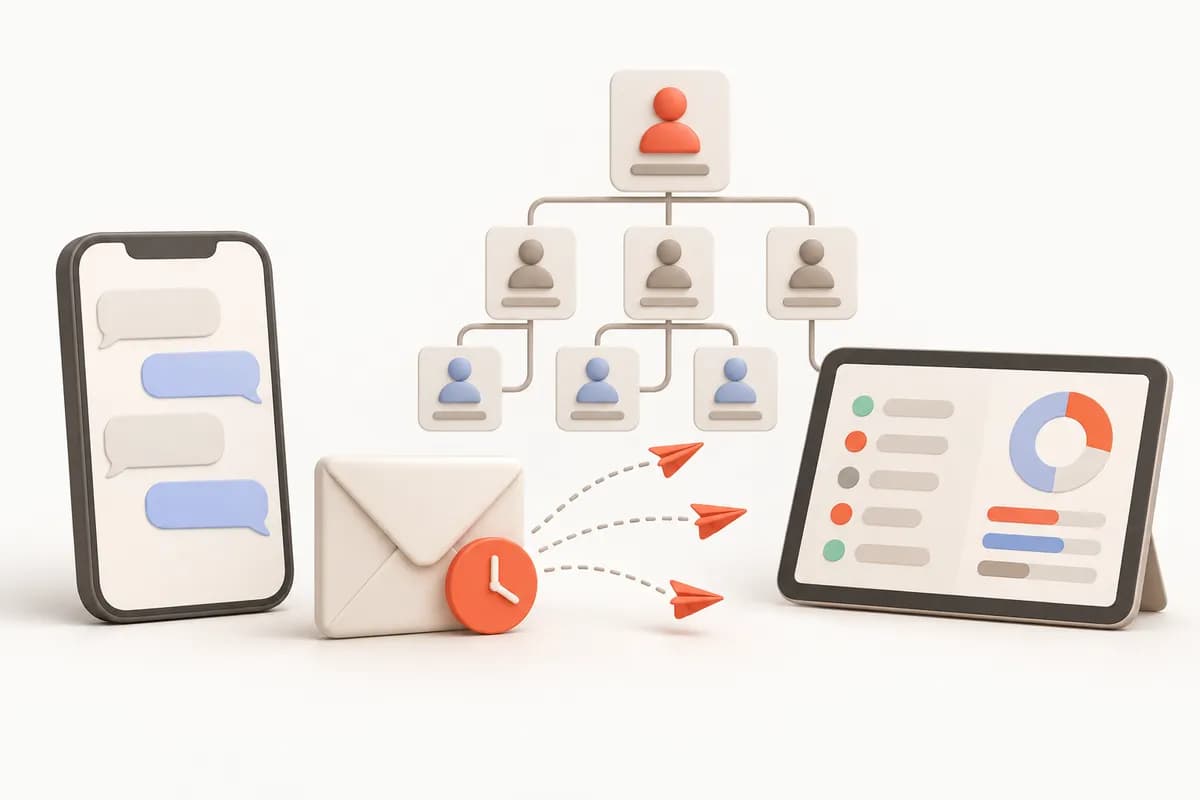
Use records to explain which account, list and sender name prepared a send. Separate reseller balance tables, opt-outs in conversations and results in provider panels make a message's history difficult to trace. Duplicate numbers also add checks during preparation. We will plan recipient groups, sending records and accounts together. Submission to the provider and delivery notifications to recipients' devices will have separate fields.
Let us choose recording order around a reseller's bulk or scheduled message. We will examine sender names, list checks and provider-returned states together. These steps help discuss the panel's business rules.
Recipient imports from CSV or spreadsheets can be scoped. Duplicate and invalid-number checks will be separate from choosing sender names approved through the provider.
Message text, template fields, timing and account balances can be considered together. Consent and opt-out checks will be scoped around message purpose and your authorised adviser's assessment.
If the provider offers access, sending and message-level status retrieval will be examined. Pending, delivered and undeliverable results can be recorded using provider codes.
We can choose the initial panel around message preparation and record checks. Reseller hierarchies and sending triggered by your own application need different permissions and connections. Together, we will decide which modules enter the first release and which fields belong in later development.
A central account preparing messages and a reseller managing sub-accounts need different visibility rules. We will select the level for balance-allocation tracking and usage reports. Using the same provider does not mean recipient lists and transactions are visible to every reseller.
| Compare central-account sending with reseller and sub-account use | Central account | Reseller and sub-account |
|---|---|---|
| Recipient visibility | Authorised central groups and sending records can be selected. | Resellers can be limited to records belonging to their own accounts. |
| Balance movements | Central usage and allocation records can be considered. | Balances allocated by parent accounts can be tracked separately from use. |
| Reporting scope | Account breakdowns can be selected for authorised aggregate summaries. | Resellers can report on their own sub-accounts' states. |
Sending and exporting the entire contact list should have different permissions. Allocating balances and changing provider connections will also be assessed separately. The software we will build can include user, reseller and sub-account boundaries alongside person-linked action records.
Account boundaries can be selected for lists, message histories and sub-account actions. Central authorised roles will be defined separately without assuming sharing between resellers.
API keys, sender selection and balance corrections can have distinct access. A balance movement's source and relationship to message usage can be assessed separately.
KVKK, Turkey's personal data protection law, retention and export needs will be considered for phone numbers; you are the data controller. Commercial-message consent, opt-outs, Turkey's İYS system and relevant requirements will be assessed with your authorised adviser.
Recipient checks need to continue after the first list import. An opt-out may arrive while a scheduled message waits, or a number's consent source may be missing. We will scope consent states, opt-out records and fresh checks before sending. Timing changes will include decisions on which user's action to record and when lists need checking again. Setting uncertain-consent numbers aside for review can be a project rule. Message purpose and applicable legal conditions will be assessed by your authorised team and adviser.
Review account ownership and consent sources alongside number lists before transfer. We will assess table formats using sample data in place of real phone numbers. Together, we will select authoritative records for reseller hierarchies and opening balances.
Number formats, groups, accounts and consent sources can be mapped. Handling duplicates and marking uncertain consent can enter project checks.
Compare reseller and sub-account relationships and starting balances in a sample transfer. Your acceptance checks can assess opt-out lists against accounts and message types.
With API access, examine send acceptance, delivery reports and errors. Rules preventing unintended repeat sends on retries will be scoped according to technical capabilities.
Consider which account and recipient a message request from your system should belong to. Service and project pages offer examples for discussing triggers and record handovers. Reseller boundaries and consent checks will be specific to your business model's scope.
Prepare shareable reseller hierarchies, blank recipient tables and provider-code examples. Remove real numbers and access keys. Explain how you handle changed opt-outs for scheduled messages today to select the initial checking scope.
The proposal will reflect sending workflows, account hierarchy, checks and connection limits. Software subscriptions, provider transmission terms and support scope will be discussed separately in writing.
We do not sell an off-the-shelf package: we design the software around your workflow, build the first version in short steps and keep running it after launch.
We listen to how your business works, your team and the tools you use today.
Modules, priorities and price are set out in a written quote.
We show working versions at short intervals and move on with your feedback.
We move your existing records across and help your team get started.
We run the software on a subscription and keep it up to date and secure.
Messages are sent through a licensed operator or an authorised SMS provider. You can contract the provider directly, or the provider is chosen together during scoping; the panel connects to that provider's interface. Delivery and sending conditions depend on the provider.
Sender IDs have to be approved through the provider. That is an administrative process outside the software; the panel is set up to send with your approved sender IDs.
Obtaining recipients' consent for commercial messages and meeting the obligations of İYS (İleti Yönetim Sistemi), the Turkish commercial message management system, are your responsibility, and in a reseller structure each reseller's responsibility for its own sending. The software can provide tools such as opt-out lists, consent records and blocking of opted-out numbers; a connection to İYS is scoped per project. We do not give legal advice.
Each reseller has its own panel, credit balance and customers. Credit is allocated top-down and usage is reported bottom-up; a reseller sees only the accounts beneath it. The number of levels and reseller permissions are decided in the scope.
Yes, this can be scoped. With an API using key-based authorisation, your own application can trigger individual messages such as order confirmations or appointment reminders directly.
Sent means the message has left the panel and reached the provider; delivered means the operator has reported that it reached the handset. Reports show the status and reason codes returned by the provider for each message.
List preparation and pre-send checks can be separate records. Rechecking current opt-outs and consent will follow your selected workflow and conditions defined by your adviser.
Correction movements can remain separate from usage records. Discovery will define who may correct balances with reasons and how movements compare with provider reports.
After a discovery meeting we prepare a written quote covering the scope, the modules and the setup work. The software is provided on a monthly or annual subscription.
In our standard model the software is provided on a subscription and the source code is not transferred. If you need a different model, it is agreed in a separate written contract.
We build and operate the software. The business using it is responsible for how it is used, the data entered and the content published; the details are set out in the service agreement.
Appointments and Client Management
We build an appointment system around your business that brings online booking, staff and room calendars, reminders and a waiting list together, with optional AI assistance.
ViewDigital Publishing & Media
We build news site software that brings the reporter-to-editor workflow, front page and ad slots, subscriptions, archive migration and editorial logs together in one panel.
ViewAI & Content Operations
We build a panel that runs your content from title to publication: AI drafts to your rules, your editor edits and approves, and publishing follows the calendar.
ViewShare your account diagram and sample records so we can choose the first release of the panel to develop.