First item check
- Home collection
- The driver's intake at the customer's address will be scoped.
- Branch intake
- Branch-to-central-facility handover will be considered separately.
Item tracking for your carpet cleaning facility
Carpet Cleaning PlantsReview each collected carpet's label, measurements and delivery in the same item record. We will define the carpet cleaning software we will build around your processing stages, drying area and collection vehicle routine.
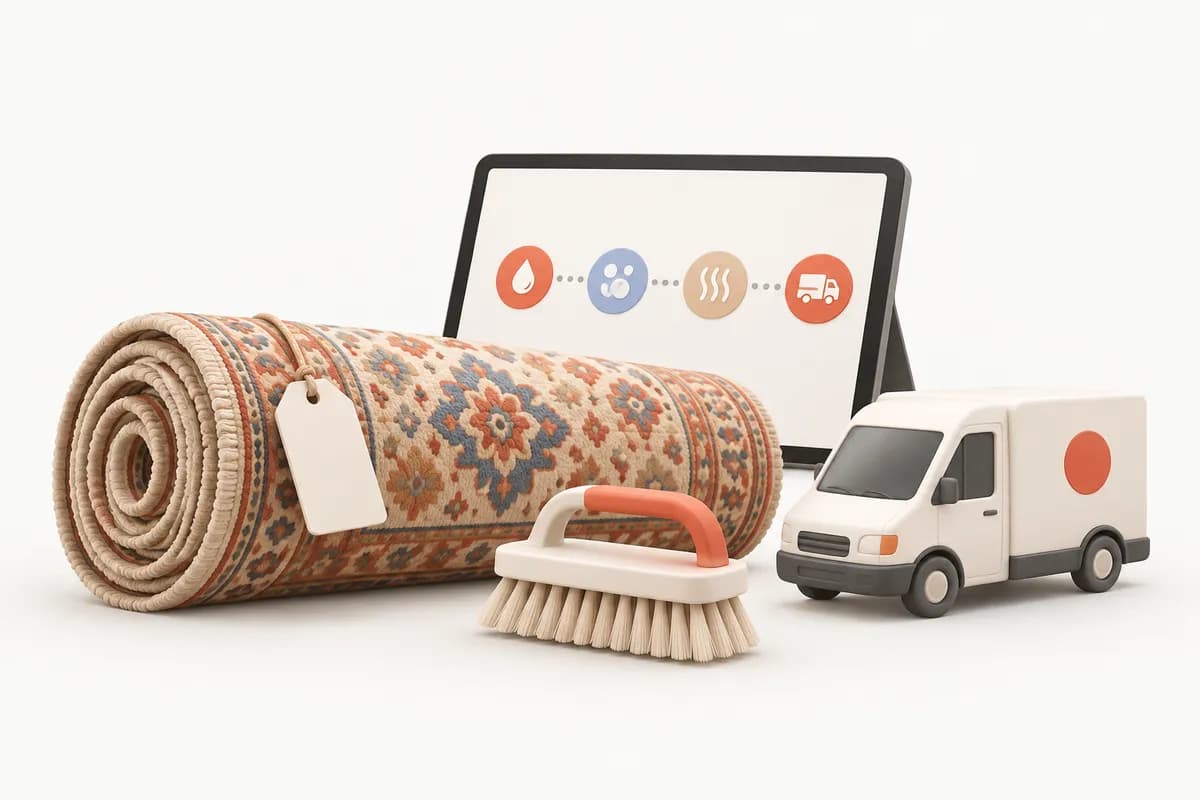
When several carpets come from one customer, the order's overall status does not explain where each item is. One may be drying while another is being packed. Separate labels and measurement notes can also obscure which charge belongs to which carpet. You need to review customer item counts alongside processing states. The software we will build will link each carpet record to its order. Collection, facility intake and delivery will be different checkpoints. Matching items brought in and taken back by vehicles can also be selected for scope.
Consider carpets collected after a customer's telephone request. Vehicle planning organises the visit; item labels organise processing. Explain stage order so we can choose scanning points. The project will discuss which state each scan changes and how missing labels are checked. Drying-area occupancy may inform delivery planning; we will separately identify who approves the day communicated to customers. Delivery and payment can be separate records within the same visit.
Collection requests can link to neighbourhoods and vehicles. Driver item counts and label-to-order matching will be scoped around your intake routine.
Intake, dust removal, washing, drying and packing can be selected. Measurement entry points and additional treatment notes will follow your method.
Adding packed items to delivery lists, counting them and recording delivery can be designed. Collections will be assessed separately through vehicle and order links.
Labels and stage tracking can be prioritised initially to distinguish items. Measurements and payments may also enter the first release according to daily workload. Service pricing methods in the software we will build will use your definitions. Square-metre carpet calculations and per-item duvet calculations can have different rules. If branches act as collection points, central intake and return routing will be discussed. Hardware and labels will be assessed against washing conditions and the planned processing workflow.
For home collection, the vehicle team first links items to the customer. Branch intake adds a handover to the central cleaning facility. Explain whether branches only accept items so we can define counts and label checks at each point. Returning an item to the customer or the intake branch can also be a recorded decision. This comparison links the same cleaning stages to different entry and exit routines.
| Handovers for home-collected carpets and items arriving from branches | Home collection | Branch intake |
|---|---|---|
| First item check | The driver's intake at the customer's address will be scoped. | Branch-to-central-facility handover will be considered separately. |
| Source information | Items will link to orders and collection vehicles. | The intake branch and central transfer can be recorded per item. |
| Delivery destination | The delivery vehicle and customer address are assessed together. | Return to the branch or direct customer delivery can be selected. |
Processing staff may not need the customer's entire contact file to record washing stages. Drivers need addresses for assigned collections and deliveries. The software we will build will design separate access for these tasks. Measurement changes, discounts and vehicle cash corrections will have selected decision owners. Customer addresses, telephone numbers and delivery photographs will be assessed under KVKK, Turkey's personal data protection law, alongside retention and sharing needs. Messaging consent and relevant legislation will be discussed if a channel is selected.
Assigned addresses, item counts and necessary delivery payment fields will be selected. Other vehicles' customer lists require separate visibility decisions.
Permissions for label scans, stage changes and measurements can be defined. Correcting earlier measurements will be discussed separately with management.
Discount and payment corrections can be scoped with user records. Your business is the customer data controller.
Measurements reported at collection may differ from those taken at the facility. First decide which will determine the final calculation. Additional stain treatment and damage found at intake are separate assessments. Initial intake notes, measurements and later treatment decisions can link to the item. You choose measurement stages and how customers hear about changes. Recording stains or damage can be distinguished from recording treatment outcomes. Additional charges, management approval and information shown at delivery will also enter scope discussions.
An old customer list may support future collections; carpets currently at the facility need their starting item states. We will review these data groups separately. Anonymised examples show label, measurement, stage and account relationships. Outstanding collections can be compared with vehicle records. You will select checks for missing labels or stages. The project will consider item details rather than importing only order totals.
Repeated addresses and telephone numbers will be reviewed. Existing customer and open-order lists can be treated as separate sources.
Labels, processing stages and destinations will be checked with sample items. Records missing measurements or payment information will enter review.
Map access allows assessment of addresses and route needs. A vehicle-list method without a connection can also be discussed in scope.
Handing each item to different staff requires more detailed process design than a single customer record. Our automation service and project offer examples for considering transitions. Labels, measurements and drying conditions will be scoped from your facility's information. Listing each handover before the meeting helps choose where information should be recorded.
Start with a blank collection form, label format and processing stages. Explain who measures, what decisions stain notes prompt and how you check payments at delivery. The first release can link item tracking and accounts. Branches, drying capacity and external connections will be discussed as separate needs.
The proposal will follow selected processing stages and hardware needs. Subscription and support terms will be assessed in writing with the agreed scope.
We do not sell an off-the-shelf package: we design the software around your workflow, build the first version in short steps and keep running it after launch.
We listen to how your business works, your team and the tools you use today.
Modules, priorities and price are set out in a written quote.
We show working versions at short intervals and move on with your feedback.
We move your existing records across and help your team get started.
We run the software on a subscription and keep it up to date and secure.
The label is usually fixed to the fringe or edge with a plastic tie and made from wash-resistant material. We work out with you during discovery which label and printer suit your washing process, and the software is designed around the label format you choose.
You define the price list by carpet type, material and extra service. The software calculates the area from the measurements and applies your rate. If a discount is given at collection or delivery, the person who gave it is recorded.
Yes. You enter how many square metres your drying area holds at once; the software shows the current load and suggests delivery dates from it. Estimates are only as good as the capacity entered, and because drying takes longer in winter, you can adjust it by season.
This can be included: a status page opened with the order number, or an automatic message when the stage changes. We decide together which option suits your business.
Yes. Branches act as drop-off points and carpets travel to the central plant. Every carpet is recorded with its branch of origin and is routed back to that branch, or straight to the customer, for delivery.
Yes. Each item type is defined with its own pricing: carpets by area, duvets or curtains by piece or size, on-site upholstery cleaning by appointment. Which services are included is agreed with you during discovery.
Initial and checked measurements can be scoped separately. We will identify which measurement determines charges and who approves corrections, alongside the relevant item and additional treatment notes.
Item-level delivery states and keeping remaining items open can be designed according to need. We will choose count checks, vehicle tasks and collection relationships for partial delivery around your method.
After a discovery meeting we prepare a written quote covering the scope, the modules and the setup work. The software is provided on a monthly or annual subscription.
In our standard model the software is provided on a subscription and the source code is not transferred. If you need a different model, it is agreed in a separate written contract.
We build and operate the software. The business using it is responsible for how it is used, the data entered and the content published; the details are set out in the service agreement.
Technical Service & Device Repair
We build software that follows every device from booking-in to collection, shaped around the way your workshop and field technicians actually work.
ViewWater Purifiers & Scheduled Servicing
We build software that tracks when every filter you have fitted is due and plans your technicians' visits, organised around the way your dealership works.
ViewCourier & Parcel Operations
We build software that records every step of a parcel from intake to delivery, organised around your delivery zones and the way your couriers work.
ViewDiscuss custom software scope using your label, measurement and vehicle records.